Arguments
Arguments for the Monarchy
There are some sections of the media whose prime objective sometimes seems to be increasing circulation and making money regardless of any other factors. Concentrating on trivia and sensationalism, they ignore or under-report the invaluable role being played by The Royal Family every day throughout the country and across the world.
Events, Visits and Appointments

Royal Visit 2024 - Sydney Harbour
Take a look at the royal appointments schedules on the royal website: https://www.royal.uk/
The schedules of the “Working Royals” show the huge number of appointments that they undertake, often several on one day. Some visits concern the wide range of organisations of which Royal Family members are patrons or have a particular interest. Others are not initiated by them; they do not get up in the morning and say, “I think I'll visit a hospital today or open an exhibition or hold an investiture.” Most visits are planned months, even years, in advance. There is a constant, never-ending stream of requests from people who would like members of The Royal Family to support their events, knowing the value of a Royal Visit to all involved.
A Royal Visit will always draw crowds and, on special Royal occasions, people will camp out overnight for several days to get the best view – think of William and Kate’s wedding in April 2011. The huge support, often underestimated, for Her Late Majesty Queen Elizabeth II was seen in the national rejoicing at her Jubilees - Silver in 1977, Golden in 2002, Diamond in 2012 and, in 2022, she celebrated her Platinum Jubilee – the first British Monarch to do so. And, in September 2022 at the time of her death, people from all over the world queued for hours to pay their respects at her Lying-in-State. A Royal birth, wedding, Jubilee, funeral or Coronation is guaranteed to unite the nation.
Understanding the Role of the Royal Family
Many people are familiar with The Royal Family as a national institution but may not know the full extent of its constitutional and charitable roles. The arguments in favour of monarchy are not always widely discussed or clearly explained.
As with a number of important national institutions, there is a case for giving these issues greater prominence in schools and in wider public discussion. People should have the opportunity to understand what The Royal Family does, consider the different arguments surrounding the monarchy, and reach their own informed conclusions.
The Royal Family’s use of social media has helped make this work more accessible, allowing the public to see more directly the causes, organisations and duties with which members of The Royal Family are involved. This can help people understand the institution more fully and form their own views about its value and relevance to the country.
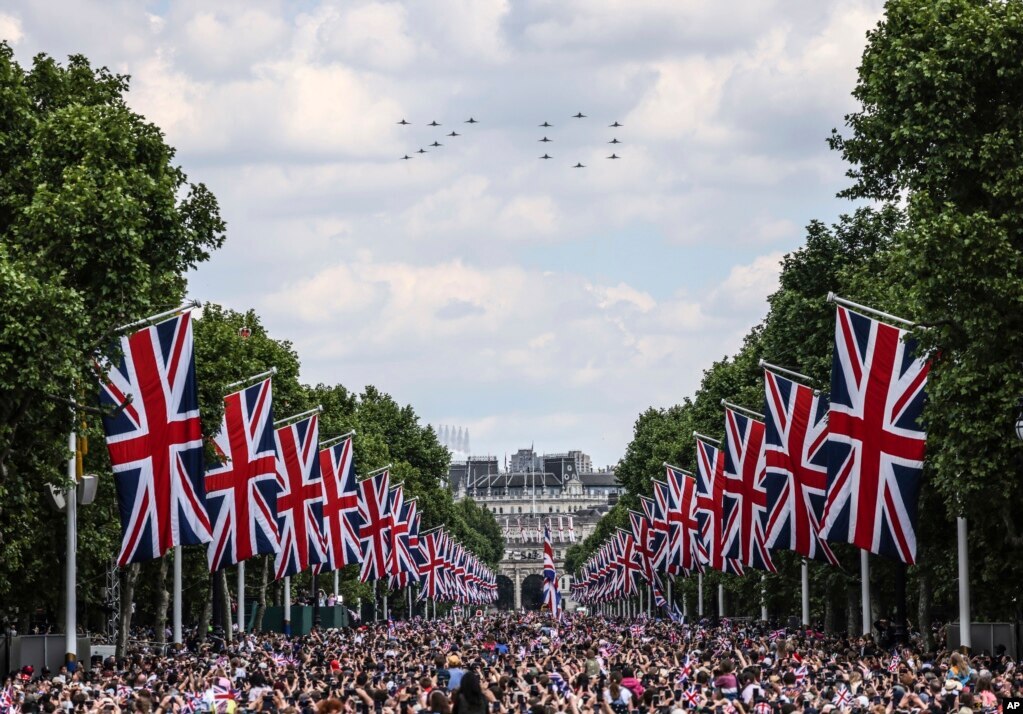
The Mall - Platinum Jubilee June 2022
Outdated or Modern?
“Britain will never become a modern democracy, nor will it be possible to create a more meritocratic and inclusive society, as long as we languish under the burden of an unelected and archaic monarchy” - quote from a republican. Constant attempts are made to suggest that the Monarchy is an outdated, anachronistic institution - feudal, in the words of some opponents, with The King as the head of the nobility and his minions beneath, rooted in the past rather than the present. This, of course, has long ceased to be the case.
In 1689, the Bill of Rights set limits on the powers of the Monarch and established the rights of Parliament, The final transition to a constitutional monarchy – one in which The Sovereign is Head of State but no longer has a political or executive role, with the ability to make and pass legislation residing with an elected Parliament – was made during the reign of Queen Victoria.

Danish Royal Fanily
Over the centuries, the Monarchy has constantly evolved and developed, modernising and reforming all the time. In April 2013, for example, The Succession to the Crown Act was passed, which altered the laws of succession (for those born after 28th October 2011) in favour of absolute primogeniture, basing it on birth order so the eldest child, regardless of sex, preceded any siblings. This Act also repealed The Royal Marriages Act 1772, ending the disqualification from succession of a person who married a Roman Catholic, plus the requirement for those past sixth in line to the throne to seek the Sovereign's approval to marry.
It is sometimes said that Britain can never be a really modern state while it still has a monarchy. This, of course, ignores countries like Spain, Norway, Sweden, Denmark, The Netherlands, Japan and many others, all of which are modern constitutional monarchies in what are recognised as modern countries.
The majority of the people of those nations have absolutely no intention of removing their monarchy because they recognise its benefits. In some countries where, in the past, they have relinquished the monarchy rather than reforming or modernizing it, many people wish it could be restored - but, often, the passage of time has been too great.
In some countries such as Afghanistan, serious attempts were made to look at the restoration of the monarchy as a valuable uniting symbol of a disparate population but it was realised that other factors had intervened which rendered this not practical.
Democratic or Autocratic?
The argument often put forward is that a monarchy is not democratic. “Why should the opportunity to hold the highest position in the land be denied the person in the street?” it is sometimes asked.
When looking at a President or Prime Minister as an alternative to monarchy, the argument against a person who is head of state as well as head of government is that too much power is concentrated in one pair of hands (despite any other checks and balances that there may be). The overall workload and responsibilities would be massive and the post would have to combine the roles of the head of government and the ceremonial duties of head of state - often incompatible and very time-consuming.
One of the advantages of a constitutional monarchy is that it can carry out a large number of the ceremonial, figurehead and nation-unifying roles instead of the President or Prime Minister, allowing that person to concentrate on matters governmental. Also, for political reasons, there could be huge difficulties with the head of government undertaking ceremonial duties with the Armed Forces. Better these be done by a person disinterested and this is, of course, one of the major roles of The Royal Family.
Elected Presidents are concerned more with their own political futures and power. Constitutional Monarchs are not subject to the influences which can corrupt short-term Presidents. A Monarch can represent centuries of history whereas elected Presidents can devote much energy to undoing the achievements of their predecessors and setting traps for their successors. With Monarchs, it is the reverse: they build on the achievements of their forebears in order to strengthen the position of their successors.
A long-reigning Monarch can put enormous experience at the disposal of transient political leaders – as was the case with our late Queen. An experienced Monarch can act as a sounding-board for politicians. Having a Monarchy and a Royal Family means that a whole family of people are undertaking valuable ceremonial and charitable duties across the country to an extent to which a President or Prime Minister just cannot compete.
The Monarchy retains only residual powers which are hardly ever used and, if they are, they are only exercised on the advice of the government of the day. Walter Bagehot, in his work “The English Constitution,” famously described the role of a King or Queen in a Constitutional Monarchy as having “the right to be consulted, the right to encourage, the right to warn.”
Nonetheless, a Constitutional Monarchy is the delightful combination of an institution which is entirely under democratic control and yet entirely above divisive election and supported by the majority of members of all political parties.
His Majesty King Charles III is the Monarch of fifteen Realms and Territories and the Head of the Commonwealth of fifty-three other countries across the globe – a massive worldwide symbol of unity. Can you imagine all these nations agreeing on an appointed, let alone elected, symbol other than a Constitutional Monarch?